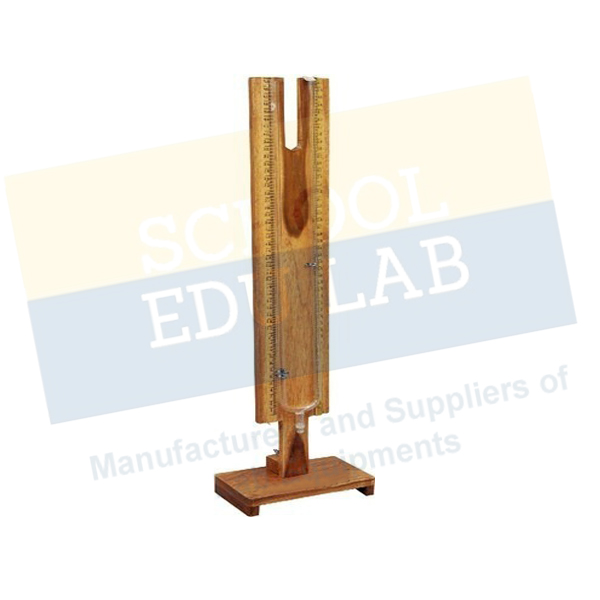
Quick Answer: Hare's apparatus compares the densities of two liquids: suction applied to the short limb draws up two columns, and their heights are read on a metre rule marked 45 cm at the top and 0 at the bottom.
Last updated: October 2026
Key Features
Mounted on a polished wooden stand
Metre rule graduated from 0 at the bottom to 45 cm at the top
Suction applied to the short limb raises two liquid columns
Used to find the densities of liquids from the column heights
About This Product
Each limb dips into a separate liquid. When air is drawn out through the short limb, both columns rise until the pressure on them balances, and the ratio of the heights gives the ratio of the densities. The heights are read directly on the rule fixed to the polished wooden stand, for practical work in school and college labs. School Educational Instrument can supply the Hare Apparatus to schools and colleges in Botswana, Morocco, Papua New Guinea, Ecuador and Georgia.
Frequently Asked Questions
How does Hare's apparatus measure the density of a liquid?
Suction on the short limb draws up two columns of liquid. Measuring their heights on the scale, which reads 0 at the bottom to 45 cm at the top, lets the densities of the liquids be compared.